
Decoding OTC Cold Labels
Health Hub · Consumer Health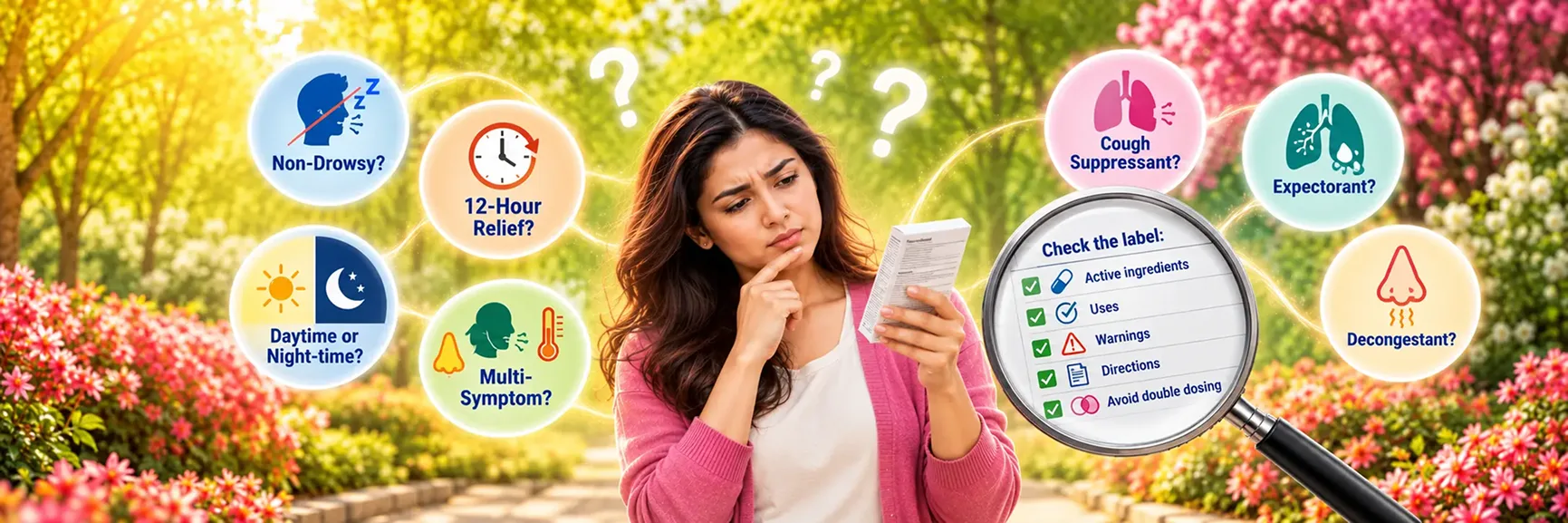
A quick, practical guide to reading cold and cough medicine packs before you buy or take them.
You have a blocked nose, a cough and a long day ahead. One pack promises “non-drowsy” relief. Another says “12-hour”. A third claims to tackle multiple symptoms. Which one should you choose?
The front of a medicine pack gives you a quick summary. The important details—what is inside, who can take it and how often—are in the ingredients, directions and warnings. [1]
What does “non-drowsy” mean?
It usually means the product is designed to be less likely to make you sleepy—not that sleepiness is impossible. Some newer antihistamines cause less drowsiness than older ones, but people can still react differently. Check the active ingredients and warnings, especially before driving or using machinery. [2,3]
Does “12-hour relief” mean you will feel better for 12 hours?
Not necessarily. It generally describes the product’s intended dosing interval or duration of action for particular symptoms. It does not promise that every symptom will disappear for exactly 12 hours. Follow the specific pack’s directions; do not take an extra dose early because symptoms return. Some products are formulated to release medicine over time. [1,3]
What do “daytime” and “night-time” formulas mean?
These labels help distinguish formulations intended for different times of day. Night-time products may contain an ingredient that causes drowsiness; daytime products may avoid it. But names alone are not enough: check each product’s ingredients, warnings and dosing instructions. Never assume the day and night versions are safe to combine without checking for overlapping ingredients. [1,2,4]
Does “multi-symptom” mean better relief?
Not always. A combination product may contain medicines for cough, congestion, fever and pain—even when you only have one of those symptoms. Match the active ingredients to the symptoms you actually have. Taking two cold products together can accidentally double up an ingredient. [1,4]
What do “cough suppressant” and “expectorant” mean?
A cough suppressant, such as dextromethorphan, helps reduce the urge to cough. An expectorant, such as guaifenesin, helps loosen mucus so it is easier to cough up. They have different purposes, so identify the kind of cough and ask a pharmacist if you are unsure. [4,5]
What does “decongestant” mean?
A decongestant aims to ease a blocked nose. Some decongestants may not be suitable for people with certain conditions, including high blood pressure. Medicated decongestant nasal sprays should only be used for the short period stated on their label, because prolonged use can worsen congestion. [5,6]
The 30-second label check
- Active ingredients: What medicines are actually inside?
- Uses: Do they match your symptoms?
- Warnings: Any concerns for your age, health conditions or other medicines?
- Directions: How much, how often and for how many days?
- Double-check: Are you already taking another product with the same ingredient?
For example, paracetamol (called acetaminophen in some references) can appear in both a cold-and-flu product and a separate pain or fever medicine. Taking both without checking can lead to too much paracetamol and serious liver harm. [7]
One last thing: OTC does not mean risk-free
“Over the counter” simply means a medicine can be purchased without a prescription. It does not mean it is right for everyone. Children, pregnant or breastfeeding people, and anyone with a long-term condition or taking other medicines should get advice from a qualified healthcare professional before choosing a product. For children, always check age restrictions and avoid using adult products. [1,4]
Bottom line: Read beyond the bold words on the front. The right choice is the medicine that fits your symptoms and is suitable for you—not the pack with the biggest promise.
Disclaimer:
This article is for general awareness and does not replace medical advice, diagnosis or treatment. Consult a doctor or pharmacist for guidance specific to you or your child.References:
- US FDA. The Over-the-Counter Drug Facts Label. https://www.fda.gov/drugs/understanding-over-counter-medicines/over-counter-drug-facts-label
- MedlinePlus. Over-the-counter medicines. https://medlineplus.gov/ency/article/002208.htm
- MedlinePlus. Antihistamines for allergies. https://www.medlineplus.gov/ency/patientinstructions/000549.htm
- MedlinePlus. Cold and Cough Medicines. https://medlineplus.gov/coldandcoughmedicines.html
- MedlinePlus. Over-the-counter medicines (cough medicines and decongestants). https://medlineplus.gov/ency/article/002208.htm
- MedlinePlus. Stuffy or runny nose – adult. https://www.medlineplus.gov/ency/article/003049.htm
- US FDA. Don’t Overuse Acetaminophen. https://www.fda.gov/consumers/consumer-updates/dont-overuse-acetaminophen